
Food & beverage · iOS & Android
Cartofisserie
A loyalty app that turns a repeat customer into a known one. Over 30000 accounts and 700+ app orders a day within two months of launch.
Read the full case study Web app developmentBuilding solutions that click.
 Product developmentFrom “I have an idea” to launch.
 Mobile developmentDesigning for humans, optimizing for screens.
 Team augmentationScaling dev teams in one week.
 QARelease with confidence, every time.
 CybersecuritySecurity that gives you peace of mind.
 DevOpsAutomate, scale and ship with confidence.
 IoT DevelopmentConnected devices, firmware to cloud.
We build AI-native
by default.
AI takes the first pass. Our senior team reviews, decides and owns the result.
Website developmentBuilding premium custom sites. Shopify DevelopmentCustom e-Commerce solutions that convert.UI/UXWhere usability meets beautiful design.
 Visual brandingCreating brand identities that last.
 SEOOptimizing for visibility and performance.AI websitesLeveraging AI to build sites faster.
Get your
quote today.
AI product integrationsBring AI into your existing product.Custom LLM appsChatbots, copilots and assistants.RAG & knowledge systemsAnswers grounded in your own data.AI automationAutomate the repetitive work.Computer visionMake sense of images & video.AI strategy & consultingFind where AI actually pays off.Forward deployed engineersOur AI engineers, inside your team.Get your
quote today.
A social app with no feed and no photos. You pick a mood, OPEN finds someone in the same one, and the two of you talk.
OPEN social merges the benefits of social media with those of meditation. It connects people whose moods are compatible, and it does it through voice only. No profile pictures to judge, no text threads to perform in. The goal is to bring back what socialising is supposed to be, and to let people build relationships across borders.
The founding team, based in Vienna, came to us with the concept already defined, plus wireframes and design templates. What they did not have was the technical team to build it in-house. They wanted a technology partner that could bring the expertise and the hands, and stay flexible while the product found its shape.
The whole product is a conversation between two strangers. Everything we built either gets them into one faster or keeps it clear once they are in it.
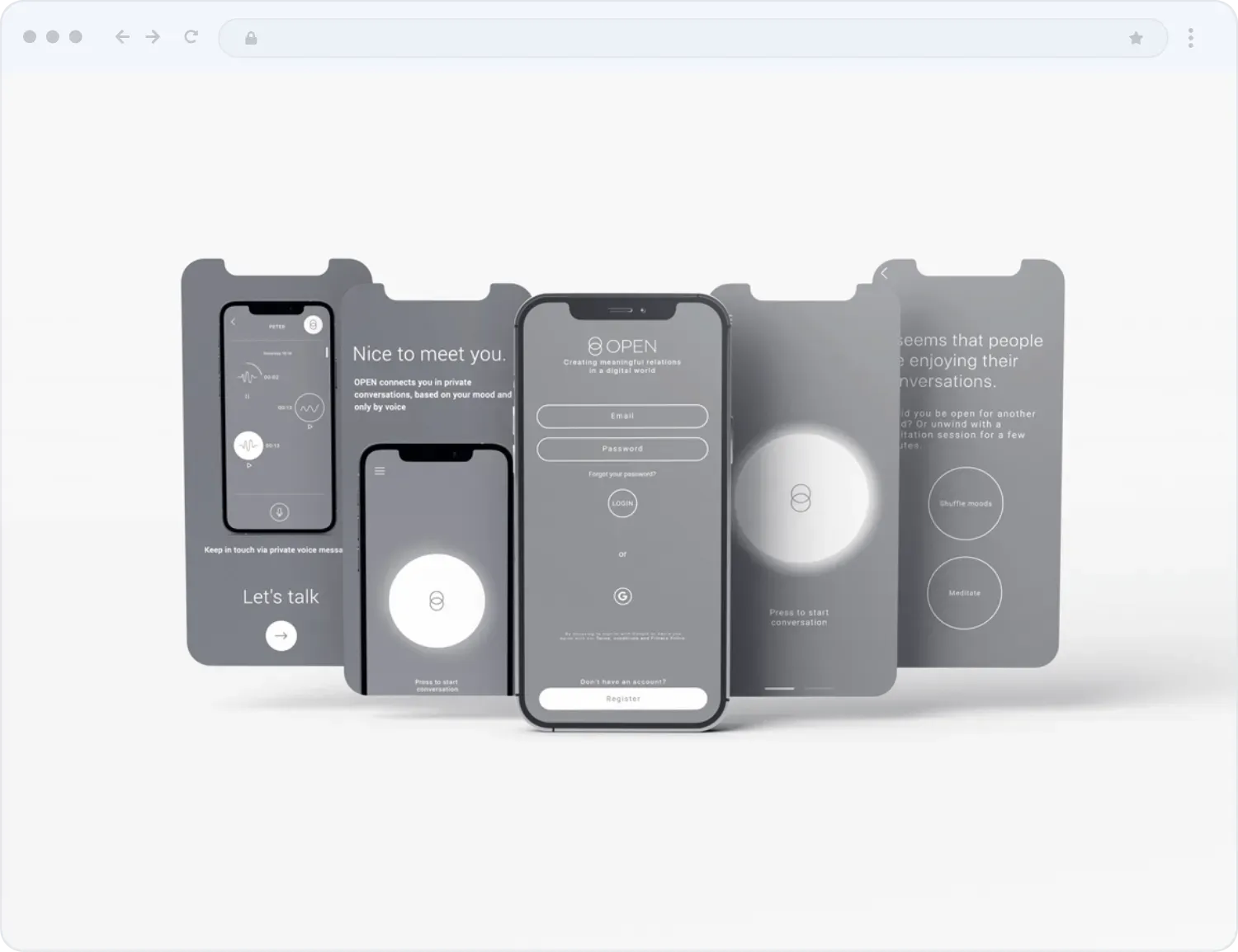
We started from the wireframes and templates and proposed a refined version of the application architecture before building anything. The result was a hybrid app in Flutter, one codebase for iOS and Android, with Firebase underneath for a database that scales with the user base.
Matching and voice were the two pieces that could make or break the product, so we did not build them from scratch. We brought in Agora to handle matching and the voice channel itself. That API choice is also where the economics changed: it cut the app’s running costs by 62% against the alternative.
Algolia handles search.
The design asked for the mood-picking screen to behave like something physical: spheres you can push around, that collide, settle and respond to touch with weight and momentum. Flutter’s own widgets cannot do that.
So we used a game engine. Flame, a 2D engine for Flutter, does the rendering, and Forge2D gives each sphere its physical properties. The engine handles the motion; we kept full control over how each mood looks. Changing or adding a mood element later is a configuration change, not a rewrite.
Serverless architecture depends on managing and routing network requests, and real-time audio is exactly where that gets unpredictable. A call also needs a stable, secure connection to sound good, which is hard to guarantee in a serverless setup. And all of it had to stay low-latency while scaling to a potentially large number of users.
The answer was to let the backend only set the call up, never carry it:
OPEN shipped as a cross-platform app with a mood picker that feels physical and a calling architecture that costs 62% less to run. Technically, it is ready to compete with the established social apps.
For us it was compelling, thought-provoking work. It deepened our expertise in serverless architecture and in social applications.
Contracting Inventiff’s services is like having a CTO on board. They get involved in the project and help shape the project, they do not just execute, but come up with improvements in all areas.
Food & beverage · iOS & Android
A loyalty app that turns a repeat customer into a known one. Over 30000 accounts and 700+ app orders a day within two months of launch.
Read the full case studyLuxury concierge · Members’ app
HCT Concierge arranges the things that are hard to arrange — tables, suites, access. The app puts that in a member’s hand without making it feel like an app.
Read the full case studyPayments · Mobile point-of-sale app
Zavolla lets a business take card payments, manage who is allowed to take them, and watch revenue in one app. No terminal on the counter unless you want one.
Read the full case studyTell us about yours
This could be the first step towards a new and successful collaboration. A one-line idea and a finished spec are both fine — tell us the problem, the deadline you’re working to and what’s in your way.
We reply within one working day.
